The sensor + app
One lumbar sensor. Every session, measured.
A lightweight wearable clips on at the waist and captures movement during a series of balance activities. ANVA turns thousands of data points into a small set of clear measures — no lab, no force plate, no setup.
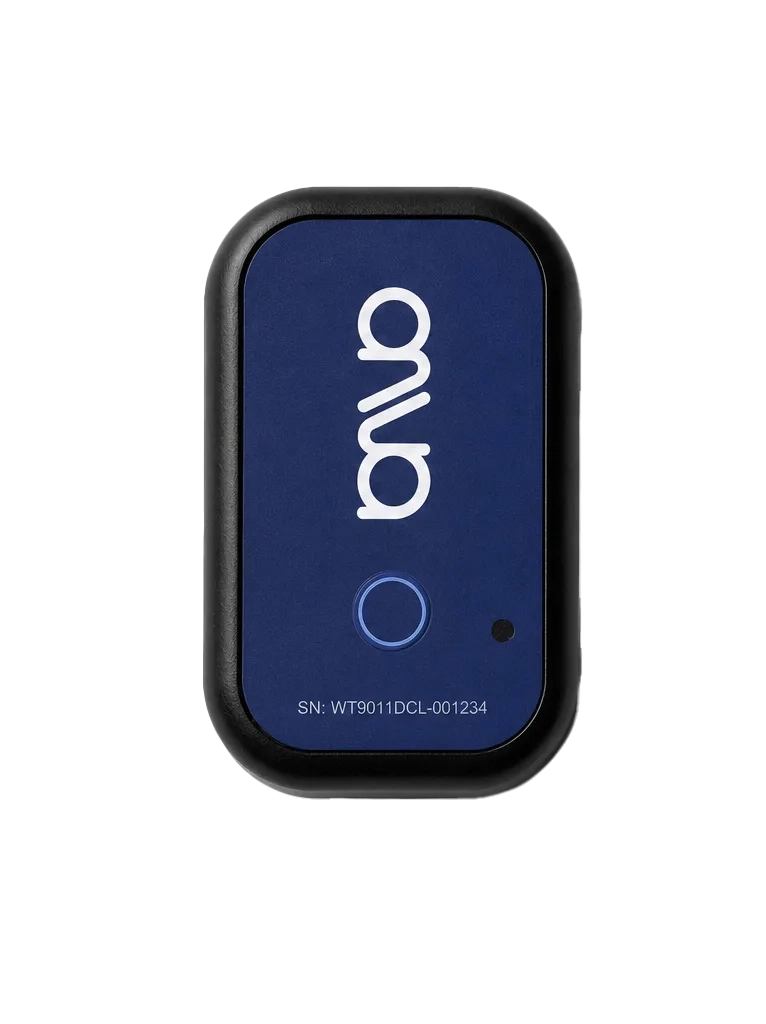
The sensor
A motion sensor small enough to forget you are wearing it.
A lightweight IMU that clips at the low back and streams trunk motion to the app. No wiring, no calibration room — set up in seconds and measure wherever you already are.
Placement & session flow
Clip it at the waist, pair with the app, run the assessment or a training session. Mirror the cues to a larger screen to follow along more easily.
Technical specs
- 9-axis motion sensor (accelerometer, gyroscope & magnetometer)
- Bluetooth 5.0 — wireless, range up to 90 m
- Up to 20 hours per charge · recharges in ~2 hours over USB-C
- Ultralight 9 g · 32.5 × 23.5 × 11.4 mm
Shipping
Ships within the United States in 3–4 days. In the box: the ANVA sensor, a USB-C charging cable, and a manual. The $129 price is a one-time purchase.
How ANVA works
Measure movement
A lightweight wearable sensor captures movement data during a series of balance tasks designed to challenge different aspects of balance.
Analyze performance
ANVA processes thousands of movement data points and evaluates all six balance domains.
Generate insights
Results are organized into meaningful domains that describe not only how you performed, but how that performance was made up.
Train balance
Interactive training activities use real-time sensor feedback to practice movement awareness, postural control, weight shifting, and stability.
Track change over time
Repeated assessments reveal meaningful improvements, emerging limitations, and long-term trends.
Understand the whole picture
Rather than a single score, ANVA provides a multidimensional view of balance performance.
Six domains of balance
Balance Capacity
The amount of movement a person can tolerate before stability is lost.
Stability Utilization
The percentage of available balance capacity being used during a task.
Continuous Stability Control
The quality, consistency, and efficiency of ongoing postural control.
Balance Recovery
The body's ability to recognize instability and restore control.
Balance Adaptability
The ability to maintain balance under progressively more challenging demands.
Balance Endurance
The ability to maintain stability, control, and efficiency throughout an activity.
Where people use ANVA
ANVA measures balance, guides training, and makes change visible over time.
- Healthy aging and staying steady
- Everyday movement confidence
- Balance training for active lifestyles
- Sports and fitness performance
- Home training programs
- Long-term progress monitoring